Decomposing a Monolith into Microservices with Call Graph Analysis
Splitting a monolith into microservices is a problem of finding boundaries. The wrong boundaries produce distributed monoliths – microservices that cannot be deployed independently because they call each other synchronously for every operation. The right boundaries follow natural seams in the code: clusters of functions that are tightly coupled internally but loosely connected to the rest of the system. This post picks up the CoolStore monolith from migrating it to Quarkus with rgctl and applies the same graph analysis to the next question: where to cut it into services.
This post walks through a concrete decomposition of a Java EE monolith using static call-graph analysis. I use rgctl to build the function-level call graph, detect community structure, measure coupling with blast radius, and identify the cuts that produce viable microservice boundaries. The goal is not to argue that you should decompose every monolith – it is to show how graph analysis replaces intuition with structural evidence when you decide to.
before we move forward, yes you can use the same functionality in tandem with an code agent as well. This is possible by using the skill provided by rgctl. The following guide explains how the skill works and how to install it.
The Monolith
The CoolStore is a Java EE 7 e-commerce application originally deployed on WebLogic. It has 25 classes across 5 packages:
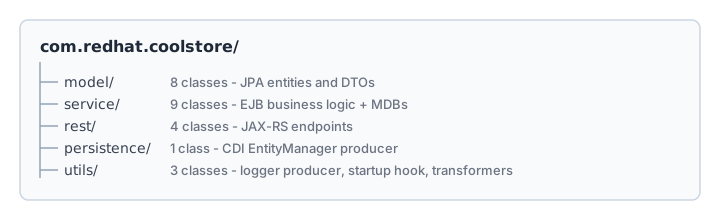
The application handles four distinct business operations:
- Catalog browsing – list products, look up inventory
- Shopping cart – add/remove items, price calculation, shipping, promotions
- Order processing – checkout publishes to JMS, MDBs persist the order
- Inventory management – deduct stock on order, low-stock alerts
In the monolith, these operations share a single database, a single JMS topic, and freely inject each other’s EJBs. The question is: which of these can become independent services, and where are the coupling points that make that hard?
Step 1: Build the Call Graph
All commands below assume the rgctl repository root, with the CoolStore example
at example/coolstore-weblogic.
$ rgctl -r example/coolstore-weblogic discover . \
    --with-cfg \
    --with-harmonic \
    --with-security \
    --export-migration-hints
[>] rgctl discover
[!] Deep analysis enabled (--with-cfg / --with-taint).
[✓] Loaded 1227 files from snapshot -> 17417 nodes, 52920 edges
[✓] Analyzed 7526 functions (avg complexity: 1.0)
[✓] Detected 13565 communities (modularity: 0.29)
[!] Found 186 circular dependencies
✓ Security analysis:
Potential secrets found: 5
✓ Control flow analysis:
Field writes indexed: 3299
CFG/PDG/Dominance: 6585 functions analyzed
Skipped: 941 functions (unsupported language or parse error)
[✓] rgctl discover finished in 16.4s186 circular dependencies. In a monolith, this is typical – EJBs inject each other, services call back into the REST layer, model objects are passed across every boundary. But for microservice decomposition, every circular dependency is a potential distributed coupling problem. I need to find which cycles can be broken and which are load-bearing.
Step 2: Detect Community Structure
rgctl uses label-propagation community detection on the call graph. This algorithm finds clusters of functions that call each other densely but have sparse connections to the outside. These clusters are candidates for microservice boundaries.
$ rgctl -r example/coolstore-weblogic -f json gql --macro-name all_communities unusedFiltering to communities with 2+ members that contain Java application code
(community IDs are assigned at discover time; labels are the stable handle
when comparing runs on the same snapshot):
| Community | Members | Label | Dominant Classes |
|---|---|---|---|
| 8064 | 30 | coolstore.model::APPLICATION_JSON | CartEndpoint, ShoppingCartService, ShoppingCart, ShippingService, PromoService |
| 4266 | 30 | coolstore.model::getCartItemTotal | ShoppingCartService, ShippingService, PromoService, Transformers |
| 11973 | 18 | coolstore.model::getProductByItemId | ProductEndpoint, ProductService, Transformers, Product, CatalogItemEntity |
| 11250 | 7 | coolstore.service::CatalogItemEntity | CatalogService, InventoryEntity |
| 4058 | 4 | coolstore.service::getPercentOff | PromoService, Promotion |
| 14643 | 5 | coolstore.rest::Order | OrderEndpoint, OrderService |
Let’s look at what the community detection is telling me by examining the members of each cluster.
Community 8064 (30 members): Cart Operations
$ rgctl -r example/coolstore-weblogic -f json gql \
    "MATCH (f:Function) WHERE f.community_id = '8064' RETURN f LIMIT 50"
CartEndpoint.add CartEndpoint.delete
CartEndpoint.set CartEndpoint.dedupeCartItems
CartEndpoint.getCart CartEndpoint.checkout
ShoppingCartService.getShoppingCart ShoppingCartService.getProduct
ShoppingCart.addShoppingCartItem ShoppingCart.removeShoppingCartItem
ShoppingCart.getShoppingCartItemList ShoppingCart.setShoppingCartItemList
ShoppingCartItem.setQuantity ShoppingCartItem.setPrice
ShoppingCartItem.setProduct ShoppingCartItem.getQuantity
ShoppingCartItem.toOrderItem Product.getPriceThis is the cart CRUD cluster – adding, removing, and listing items. The algorithm grouped the REST endpoint, the service, and the relevant model methods into one community because they form a tight call cycle.
Pricing and Shipping (community 4266)
ShoppingCartService.priceShoppingCart   ShoppingCartService.initShoppingCartForPricing
ShoppingCartService.lookupShippingServiceRemote
ShippingService.calculateShipping      ShippingService.calculateShippingInsurance
ShippingService.getPercentOfTotal
PromoService.applyShippingPromotions
ShoppingCart.getCartItemTotal          ShoppingCart.setCartItemTotal
ShoppingCart.setShippingTotal          ShoppingCart.getShippingTotal
ShoppingCart.setCartTotal              ShoppingCart.setCartItemPromoSavings
ShoppingCartItem.getPromoSavings
ShoppingCart.setShippingPromoSavings
This is the pricing engine – computing totals, shipping costs, and
applying shipping promotions. It pulls in ShippingService and
PromoService.applyShippingPromotions because priceShoppingCart calls both
directly.
Cart Serialization and Item Promotions
ShoppingCartOrderProcessor.process
Transformers.shoppingCartToJson        Transformers.$lambda$0
Transformers.$lambda$1
PromoService.applyCartItemPromotions   PromoService.getPromotions
Promotion.getPercentOff                Promotion.getItemId
ShoppingCartItem.setPromoSavings
ShoppingCart.getCartItemPromoSavings    ShoppingCart.getCartTotal
ShoppingCart.getShippingPromoSavings
This cluster links cart serialization (for JMS publishing) with item-level
promotions. The connection is through ShoppingCartOrderProcessor.process,
which serializes the cart, and PromoService.applyCartItemPromotions, which
reads and writes cart item prices.
Order Fulfillment and Inventory (community 11250 + order MDB cluster)
OrderServiceMDB.onMessage             OrderServiceMDB.$lambda$0
InventoryNotificationMDB.onMessage    InventoryNotificationMDB.$lambda$0
OrderService.save
CatalogService.getCatalogItemById     CatalogService.updateInventoryItems
CatalogItemEntity.getInventory
InventoryEntity.getQuantity           InventoryEntity.setQuantity
Order.getItemList                     OrderItem.getProductId
This is the order fulfillment pipeline – the two MDBs that listen on the JMS
topic, persist the order, and update inventory. CatalogService appears here
because both MDBs use it: OrderServiceMDB calls updateInventoryItems and
InventoryNotificationMDB calls getCatalogItemById to check stock levels.
Product Catalog (community 11973)
ProductEndpoint.listAll               ProductEndpoint.getProduct
ProductService.getProducts            ProductService.getProductByItemId
ProductService.$lambda$0
CatalogService.getCatalogItems
Transformers.toProduct
Product.setItemId  Product.setPrice  Product.setLocation
Product.setQuantity  Product.setLink  Product.setDesc  Product.setName
Product listing and lookup. CatalogService.getCatalogItems provides the JPA
query, Transformers.toProduct maps entities to DTOs, and ProductEndpoint
exposes the REST API.
Order Queries (community 14643)
OrderEndpoint.listAll      OrderEndpoint.getOrder
OrderService.getOrders     OrderService.getOrderById
Simple read path for orders. Just an endpoint and a service with JPA queries.
Step 3: Map the Proposed Microservice Boundaries
The communities suggest four natural services, but with complications. Let me map them out and then use blast radius to quantify the coupling at each boundary.
Proposed services
Based on the community structure:
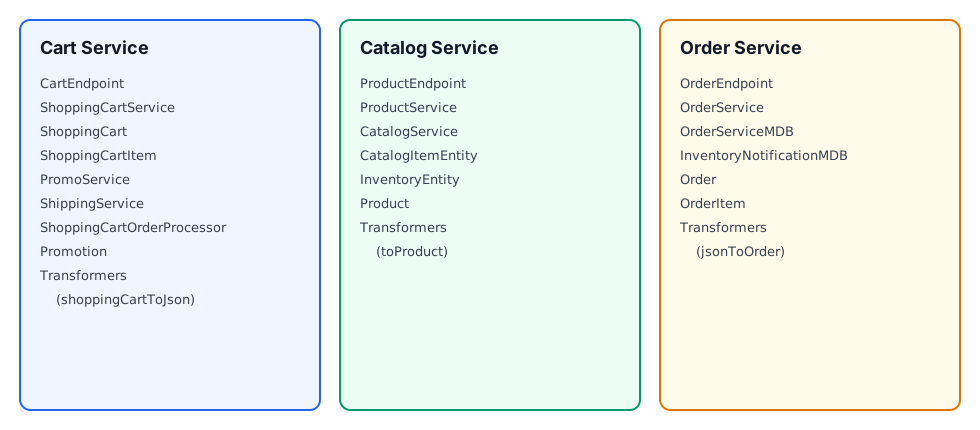
The communities group naturally into three services. But look at the problems:
CatalogServiceappears in two communities – it is called by the product listing path (community 11973) and by the order fulfillment path (community 11250 – MDBs callCatalogServicefor inventory operations).Transformersis split across three services –toProductbelongs with catalog,shoppingCartToJsonwith cart,jsonToOrderwith orders.PromoServicespans two communities –applyCartItemPromotionsis in community 4058 (item promotions) andapplyShippingPromotionsis in community 4266 (pricing and shipping).ShoppingCartService.getProductcallsProductService.getProductByItemId– a synchronous cross-service call.
These are not trivial issues. They are the structural coupling that makes monolith decomposition hard. Let’s use blast radius to quantify them.
Step 4: Quantify Coupling with Blast Radius
Blast radius tells you: if I change this function, how many upstream callers break? For microservice decomposition, I care specifically about functions that are called across the proposed service boundaries – these become the API contracts between services.
Cross-boundary calls
Query the call graph for edges between Java classes:
$ rgctl -r example/coolstore-weblogic -f json gql \
    "MATCH (a:Function)-[:CALLS]->(b:Function) RETURN a,b LIMIT 5000"
Filtering to cross-class calls between Java files, the significant inter-service edges are:
| Source (proposed service) | Target (proposed service) | Call |
|---|---|---|
| Cart | Catalog | ShoppingCartService.getProduct→ ProductService.getProductByItemId |
| Cart | Catalog | ShoppingCartOrderProcessor.process→ Transformers.shoppingCartToJson (shared) |
| Order | Catalog | OrderServiceMDB.onMessage→ CatalogService.updateInventoryItems |
| Order | Catalog | InventoryNotificationMDB.onMessage→ CatalogService.getCatalogItemById |
| Order | Cart | Transformers.jsonToOrder (shared code, both need it) |
Blast radius at the boundaries
Now let’s check the impact of the key boundary functions:
$ rgctl -r example/coolstore-weblogic -f json blast-radius getShoppingCart
$ rgctl -r example/coolstore-weblogic -f json blast-radius priceShoppingCart
$ rgctl -r example/coolstore-weblogic -f json blast-radius getCatalogItems
$ rgctl -r example/coolstore-weblogic -f json blast-radius getProducts
$ rgctl -r example/coolstore-weblogic -f json blast-radius toProduct
$ rgctl -r example/coolstore-weblogic -f json blast-radius save --class OrderService
$ rgctl -r example/coolstore-weblogic -f json blast-radius onMessage --class OrderServiceMDB
$ rgctl -r example/coolstore-weblogic -f json blast-radius calculateShipping --file ShippingService.java| Function | Score | Direct Callers | Impact Zone | Proposed Service |
|---|---|---|---|---|
ShoppingCartService::getShoppingCart | 40.5 | 6 | 10 | Cart |
ShoppingCartService::priceShoppingCart | 40.4 | 5 | 7 | Cart |
ProductService::getProducts | 40.1 | 2 | 2 | Catalog |
Transformers::toProduct | 40.7 | 2 | 14 | Catalog |
Transformers::jsonToOrder | 40.1 | 2 | 2 | Order |
Transformers::shoppingCartToJson | 25.2 | 1 | 4 | Cart |
PromoService::applyCartItemPromotions | 25.4 | 1 | 8 | Cart |
CatalogService::getCatalogItems | 25.1 | 1 | 3 | Catalog |
CatalogService::updateInventoryItems | 25.1 | 1 | 1 | Catalog |
OrderService::save | 25.1 | 1 | 1 | Order |
OrderServiceMDB::onMessage | 0.0 | 0 | 0 | Order |
ShippingService::calculateShipping | 0.0 | 0 | 0 | Cart |
Transformers::toProduct has the highest blast radius at 40.7 with 14 nodes in
the impact zone. This is a utility function that maps JPA entities to DTOs. It
is called by both ProductService.getProducts (catalog browsing) and
ProductService.getProductByItemId (called from the cart service). If you
change this function, 14 upstream functions are affected – across two proposed
service boundaries.
What the ShoppingCart mutations tell me
I can also use CPG field mutation analysis to understand the data coupling:
$ rgctl -r example/coolstore-weblogic -f json cpg mutations --type ShoppingCart --exclude-ctors{
"mutations": [
{"function": "setShoppingCartItemList", "member": "shoppingCartItemList", "kind": "ThisField"},
{"function": "setCartItemTotal", "member": "cartItemTotal", "kind": "ThisField"},
{"function": "setShippingTotal", "member": "shippingTotal", "kind": "ThisField"},
{"function": "setCartTotal", "member": "cartTotal", "kind": "ThisField"},
{"function": "setCartItemPromoSavings", "member": "cartItemPromoSavings", "kind": "ThisField"},
{"function": "setShippingPromoSavings", "member": "shippingPromoSavings", "kind": "ThisField"}
]
}Six fields are mutated on ShoppingCart by functions spread across community
8064 (cart CRUD) and community 4266 (pricing and shipping) and community 4058 (item promotions). The cart object
is a shared mutable structure that both ShoppingCartService, PromoService,
and ShippingService write to. In a monolith, this works because they all
operate on the same in-memory object. In microservices, you need to decide who
owns this state.
Step 5: Make the Cuts
With the structural data in hand, here are the decomposition decisions and the reasoning behind each.
Service 1: Catalog Service
Scope: Product listing, inventory queries, entity-to-DTO mapping.
Classes:
ProductEndpoint(REST API)ProductService(business logic)CatalogService(JPA queries) – but only the read path:getCatalogItems,getCatalogItemByIdCatalogItemEntity,InventoryEntity(JPA entities)Product(DTO)Transformers.toProduct(mapping logic – inlined into this service)
Why these boundaries work: Communities 11973 and 11250 form a clean cluster
with only one outbound dependency: ProductService is called by
ShoppingCartService.getProduct in the cart service.
API contract: Expose a REST endpoint that the cart service calls instead of
injecting ProductService directly:
// Catalog Service: src/main/java/com/redhat/coolstore/catalog/ProductResource.java
@Path("/api/products")
@ApplicationScoped
public class ProductResource {

    @Inject
    ProductService productService;

    @GET
    @Produces(MediaType.APPLICATION_JSON)
    public List<Product> listAll() {
        return productService.getProducts();
    }

    @GET
    @Path("/{itemId}")
    @Produces(MediaType.APPLICATION_JSON)
    public Product getByItemId(@PathParam("itemId") String itemId) {
        return productService.getProductByItemId(itemId);
    }
}
Blast radius validation: getCatalogItems has a score of 25.1 with only 1
direct caller (ProductService.getProducts). This call stays within the
service. The cross-service call from ShoppingCartService.getProduct ->
ProductService.getProductByItemId becomes a REST client call, which is a clean
boundary.
Service 2: Cart Service
Scope: Shopping cart lifecycle, pricing, shipping, promotions, checkout trigger.
Classes:
CartEndpoint(REST API)ShoppingCartService(cart operations + pricing)ShippingService(shipping cost calculation)PromoService(promotion rules)ShoppingCartOrderProcessor(publishes checkout event)ShoppingCart,ShoppingCartItem,Promotion(model objects)
Why these boundaries work: Communities 8064 and 4266 (plus community 4058 for item
promotions) forms the cart operations cluster. Despite label-propagation
sometimes splitting cart, pricing, and promotions into adjacent communities,
they share a tight internal coupling: priceShoppingCart calls both
ShippingService and PromoService, and checkOutShoppingCart calls
ShoppingCartOrderProcessor. These are all synchronous, performance-sensitive
calls that belong together.
The CatalogService coupling: ShoppingCartService.getProduct calls
ProductService.getProductByItemId, which calls
CatalogService.getCatalogItemById. This is the only synchronous cross-service
dependency from cart to catalog. Replace the EJB injection with a REST client:
// Cart Service: replaces the direct ProductService injection
@ApplicationScoped
public class CatalogClient {

    @Inject
    @RestClient
    CatalogApi catalogApi;

    public Product getProduct(String itemId) {
        return catalogApi.getByItemId(itemId);
    }
}

@RegisterRestClient(configKey = "catalog-api")
@Path("/api/products")
public interface CatalogApi {

    @GET
    @Path("/{itemId}")
    Product getByItemId(@PathParam("itemId") String itemId);
}
# application.properties
quarkus.rest-client.catalog-api.url=http://catalog-service:8080Checkout becomes an event: ShoppingCartOrderProcessor.process currently
publishes to a JMS topic. In the microservices version, this becomes a message
to a shared broker (Kafka or AMQP). The cart service is the producer; the order
service is the consumer. This is already an asynchronous boundary in the
monolith – JMS was doing the right thing.
// Cart Service: checkout event publisher
@ApplicationScoped
public class ShoppingCartOrderProcessor {

    @Inject
    @Channel("orders-out")
    Emitter<String> ordersEmitter;

    public void process(ShoppingCart cart) {
        ordersEmitter.send(Transformers.shoppingCartToJson(cart));
    }
}
Blast radius validation: getShoppingCart has a score of 40.5, but all 6
direct callers are within the cart service (CartEndpoint.add, .delete,
.set, .getCart, .dedupeCartItems, and ShoppingCartService.checkOutShoppingCart).
The blast radius stays internal. The only outbound edge is the checkout event,
which is asynchronous.
Service 3: Order Service
Scope: Order persistence, order queries, inventory deduction, low-stock alerts.
Classes:
OrderEndpoint(REST API for order queries)OrderService(JPA persistence for orders)OrderServiceMDB-> becomesOrderEventConsumer(consumes checkout events)InventoryNotificationMDB-> becomesInventoryAlertConsumerOrder,OrderItem(JPA entities)
Why these boundaries work: The order MDB cluster and communities 11250 and 14643 form the order processing cluster. The MDBs have blast radius 0.0 – they are pure consumers with no upstream callers. This makes them ideal microservice entry points: they receive events and operate independently.
The CatalogService coupling problem: This is the hardest cut.
OrderServiceMDB.onMessage calls CatalogService.updateInventoryItems, and
InventoryNotificationMDB.onMessage calls CatalogService.getCatalogItemById.
Both need access to inventory data that lives in the catalog service’s
database.
There are two options:
Option A: REST call to catalog service (simple, synchronous)
@ApplicationScoped
public class OrderEventConsumer {

    @Inject
    OrderService orderService;

    @Inject
    @RestClient
    CatalogApi catalogApi;

    @Incoming("orders-in")
    public void onMessage(String orderStr) {
        Order order = Transformers.jsonToOrder(orderStr);
        orderService.save(order);
        order.getItemList().forEach(item ->
            catalogApi.updateInventory(item.getProductId(), item.getQuantity())
        );
    }
}
Option B: Publish inventory events (asynchronous, better decoupling)
@ApplicationScoped
public class OrderEventConsumer {

    @Inject
    OrderService orderService;

    @Inject
    @Channel("inventory-updates")
    Emitter<String> inventoryEmitter;

    @Incoming("orders-in")
    public void onMessage(String orderStr) {
        Order order = Transformers.jsonToOrder(orderStr);
        orderService.save(order);
        // Emit inventory deduction events instead of direct call
        order.getItemList().forEach(item ->
            inventoryEmitter.send(Json.createObjectBuilder()
                .add("productId", item.getProductId())
                .add("quantity", item.getQuantity())
                .build().toString())
        );
    }
}
With Option B, the catalog service would consume inventory-updates and handle
deductions internally. This eliminates the synchronous dependency entirely.
Blast radius confirms this is safe: OrderServiceMDB::onMessage and
InventoryNotificationMDB::onMessage both have scores of 0.0. Changing their
implementation (from JMS to Reactive Messaging, from direct call to event) has
zero impact on upstream callers.
The Shared Code Problem: Transformers
Transformers is the class that appears in all three services. It has three
static methods:
| Method | Blast Radius | Used By |
|---|---|---|
toProduct | 40.7 | Catalog (entity-to-DTO mapping) |
shoppingCartToJson | 25.2 | Cart (checkout serialization) |
jsonToOrder | 40.1 | Order (event deserialization) |
These are pure functions with no state and no injected dependencies. The correct decomposition is to split them:
toProductmoves into the catalog service. It depends onCatalogItemEntityandProduct, both of which are catalog-owned models.shoppingCartToJsonmoves into the cart service. It depends onShoppingCartandShoppingCartItem.jsonToOrdermoves into the order service. It depends onOrderandOrderItem.
Each method only references model classes owned by its target service. The blast radius scores confirm this is the right split: each method’s callers are entirely within its target service.
The Shared Model Problem
In the monolith, ShoppingCart, Order, Product, and their related classes
are all in one model package. In the decomposed version, each service owns its
domain model:
| Service | Owned Models |
|---|---|
| Catalog | CatalogItemEntity, InventoryEntity, Product |
| Cart | ShoppingCart, ShoppingCartItem, Promotion |
| Order | Order, OrderItem |
The boundary is clean except for one thing: Product is used by both the
catalog service (as a DTO returned by the API) and the cart service (as the
product embedded in a ShoppingCartItem). The solution is standard: the catalog
service defines and owns the Product type. The cart service either depends on
a shared catalog-api module or defines its own ProductRef DTO with only the
fields it needs (itemId, name, price).
Step 6: The Resulting Architecture
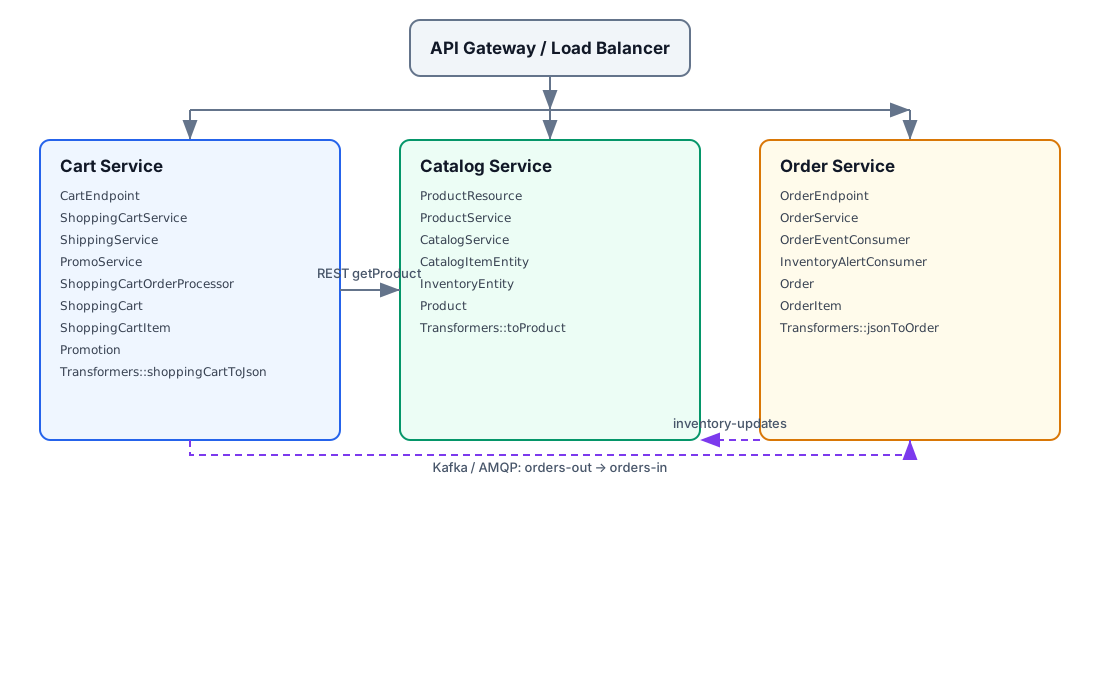
Synchronous dependencies
Only one: Cart -> Catalog for product lookups. This is a single REST call
(GET /api/products/{itemId}) used in ShoppingCartService.getProduct when
adding items to the cart. It can be cached.
Asynchronous dependencies
- Cart -> Order: checkout event (
orders-out->orders-in) - Order -> Catalog: inventory deduction event (
inventory-updates)
Both are fire-and-forget with eventual consistency.
Database ownership
Each service owns its schema:
| Service | Tables | Former JPA entities |
|---|---|---|
| Catalog | CATALOG_ITEM_ENTITY, INVENTORY | CatalogItemEntity, InventoryEntity |
| Cart | (in-memory or Redis) | ShoppingCart, ShoppingCartItem |
| Order | ORDERS, ORDER_ITEM | Order, OrderItem |
Step 7: CI Guardrails for Boundary Enforcement
After the decomposition, enforce the boundaries with a policy file:
{
  "forbidden_crossings": [
    ["cart", "catalog-internals"],
    ["order", "catalog-internals"],
    ["order", "cart-internals"]
  ],
  "max_impact_nodes": 20,
  "centrality_alert_threshold": 0.8
}
$ rgctl -r example/coolstore-weblogic -f json check --policy-file policy.jsonThis prevents re-introduction of direct cross-service calls. If a developer
adds a direct import of CatalogService in the order service, the policy check
fails in CI.
What the Graph Told Me That Intuition Would Not
A developer familiar with the CoolStore would likely suggest similar service boundaries based on domain knowledge. The graph analysis adds three things that intuition cannot:
1. It quantifies the cuts. Transformers::toProduct has a blast radius of
40.7 with 14 nodes in the impact zone spanning two proposed services. That is
a number you can use in a design review. “This function affects 14 callers
across 2 services” is more actionable than “Transformers is used in a lot of
places.”
2. It finds hidden coupling. The order fulfillment cluster groups OrderServiceMDB,
InventoryNotificationMDB, and OrderService.save by call density. Community
11250 groups the CatalogService inventory methods they call. This is
not obvious from the package structure – CatalogService is in the service
package alongside cart-related EJBs, but functionally it is tightly coupled to
the order fulfillment pipeline through inventory operations. The community
detection surfaced this relationship from the call graph, not from naming
conventions.
3. It validates the cuts are safe. Both MDBs have blast radius 0.0. This
means converting them from JMS @MessageDriven beans to Reactive Messaging
@Incoming consumers has zero static impact on the rest of the codebase. The
graph proves the refactoring is isolated, which is exactly what you want for a
high-risk change like switching messaging infrastructure.
When Not to Decompose
The analysis also tells you when decomposition is a bad idea. The ShoppingCart
mutations analysis showed 6 fields mutated by functions spread across 3
communities. If you tried to split PromoService and ShippingService into
separate services from the cart, every pricing operation would require
synchronous round-trips to apply promotions, calculate shipping, and update
totals. The graph coupling is too dense.
This is why communities 8064 and 4266 – despite being separate label-propagation
clusters – end up in one cart service. The community detection correctly
identifies distinct functional clusters at finer resolution, but the shared
mutable state (the ShoppingCart object) makes them inseparable at deployment
time.
Try it out
Stop migrating by spreadsheet and tribal knowledge. If you are staring down a monolith and wondering where the hidden dependencies are, let the call graph tell you.
- Get the tool: Grab
rgctlfrom GitHub. - Test it on your own codebase: Navigate to your project root and run
rgctl discover . --export-migration-hintsto index your application. - Stop guessing: Run
rgctl blast-radiuson your most heavily-used service and see exactly what you will break before you write a single line of code.
If rgctl saves you from a broken build or a doomed migration sprint, star the repository. Drop into the GitHub Discussions to share your custom agent recipes—or just to show off your most horrifying circular dependency graph.
Commands Reference
# Build the graph with full analysis (from the rgctl repo root)
rgctl -r example/coolstore-weblogic discover . --with-cfg --with-harmonic --export-migration-hints

# List communities (natural code clusters)
rgctl -r example/coolstore-weblogic -f json gql --macro-name all_communities unused

# Inspect community members
rgctl -r example/coolstore-weblogic -f json gql \
    "MATCH (f:Function) WHERE f.community_id = '<id>' RETURN f LIMIT 25"

# Map call edges between functions
rgctl -r example/coolstore-weblogic -f json gql \
    "MATCH (a:Function)-[:CALLS]->(b:Function) RETURN a,b LIMIT 5000"

# Check blast radius at a boundary
rgctl -r example/coolstore-weblogic -f json blast-radius <method>
rgctl -r example/coolstore-weblogic -f json blast-radius <method> --class <ClassName>
rgctl -r example/coolstore-weblogic -f json blast-radius <method> --file <ClassName>.java
rgctl -r example/coolstore-weblogic blast-radius <method>  # human-readable output

# Analyze field mutations for shared-state coupling
rgctl -r example/coolstore-weblogic -f json cpg mutations --type <ClassName> --exclude-ctors

# Enforce service boundaries in CI
rgctl -r example/coolstore-weblogic -f json check --policy-file policy.json