Enforcing Architecture with rgctl Policy Checks
rgctl (Reachability Graph Control) indexes a codebase into a compact knowledge graph – functions, classes, calls, inheritance, communities – and serves deterministic, structured answers to questions about architecture, impact, and data flow. You run rgctl discover . once, and every subsequent query (blast-radius, metrics, gql) returns sub-millisecond results from the persisted graph. Agents and humans get the same exact facts. No re-reading source files, no confident guesses, no context window gymnastics.
This post is not about querying the graph. It is about using it to enforce rules – automatically, in CI, on every pull request. We will use a real Java EE monolith as the worked example: the CoolStore WebLogic application.
The example project: CoolStore WebLogic
CoolStore is a Java EE e-commerce monolith originally built for WebLogic. It has a REST layer (CartEndpoint, OrderEndpoint, ProductEndpoint), a service layer (ShoppingCartService, CatalogService, PromoService, OrderService, ShippingService), JPA model classes, and a JavaScript frontend with bundled vendor libraries (lodash, d3, jQuery DataTables, Angular). It is small enough to follow along, but structurally interesting – the vendor JavaScript creates deep call graphs that dwarf the Java application code.
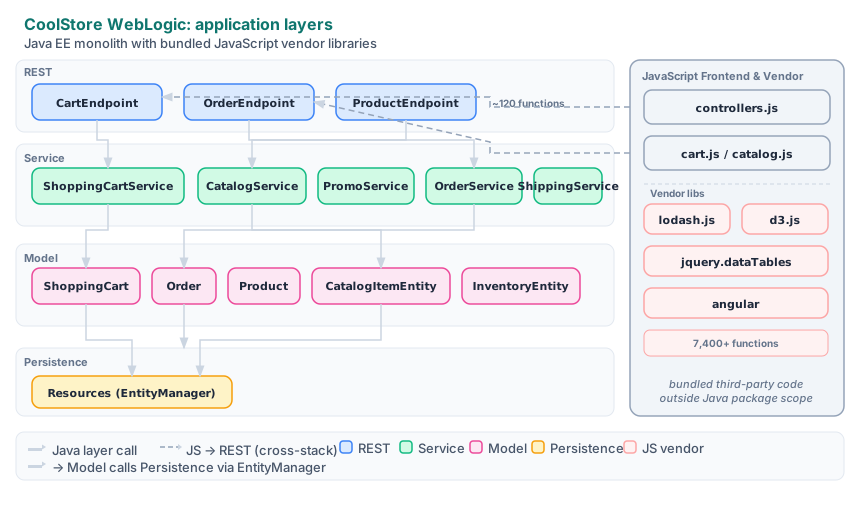
Clone it and index:
git clone https://github.com/sshaaf/coolstore-weblogic.git
cd coolstore-weblogic
rgctl discover .
[>] rgctl discover
==> Analyzing: coolstore-weblogic
[✓] Loaded 1227 files from snapshot -> 17417 nodes, 52920 edges (0.0s)
[✓] Analyzed 7526 functions (avg complexity: 1.0, 0 high, 0 medium)
[✓] Detected 13565 communities (modularity: 0.29)
[*] Top hotspot: replace (PageRank: 0.0502)
[!] Found 186 circular dependencies
[✓] Analysis complete
[✓] Saved to .rgctl/ (2.9 MB total)
[✓] Completed in 0.6s17,417 nodes, 52,920 edges, indexed in under a second. The graph is now on disk at .rgctl/ and ready for policy checks.
The problem: architecture rules that live in people’s heads
Every team has architectural constraints. “The payments module must not depend on legacy.” “No single function should affect more than 50 downstream consumers.” “High-centrality bridge functions need extra review.” These rules exist as tribal knowledge, communicated in onboarding docs and code review comments. They are enforced manually, inconsistently, and after the fact.
Manual enforcement has three failure modes:
- Drift. The rule is forgotten. A new dependency slips in. Nobody notices until it causes a production incident three months later.
- Ambiguity. “Too much coupling” means different things to different reviewers. Without a number, every review is a negotiation.
- Scale. On a codebase with 7,500 functions, no human can evaluate the blast radius of every changed function in a pull request.
rgctl’s check command solves this by turning architecture rules into a JSON policy file that a CI pipeline can evaluate automatically.
Policy file format
A policy file is a JSON object with up to four fields:
{
  "max_impact_nodes": 50,
  "centrality_alert_threshold": 0.8,
  "forbidden_crossings": [["legacy", "payments"]],
  "node_domains": {
    "550e8400-e29b-41d4-a716-446655440000": "legacy",
    "6ba7b810-9dad-11d1-80b4-00c04fd430c8": "payments"
  }
}
Every field is optional. Omitted fields default to unlimited (no constraint).
| Field | Type | Default | What it checks |
|---|---|---|---|
max_impact_nodes | integer | unlimited | Fails if any function’s blast-radius impact zone exceeds this count |
centrality_alert_threshold | float | unlimited | Fails if any reached node has betweenness centrality above this value |
forbidden_crossings | [[string, string], ...] | [] | Fails if a blast-radius path crosses between the named domain pair |
node_domains | { "uuid": "domain" } | {} | Maps node UUIDs to domain labels used by forbidden_crossings |
The simplest possible policy is one field:
{"max_impact_nodes": 25}This says: no function in the codebase may have a blast radius larger than 25 nodes. If any function exceeds that threshold, the check fails.
Violation types
When a policy rule is broken, rgctl reports a structured violation. There are four types:
ScaleFailure
Triggered when a function’s impact zone exceeds max_impact_nodes.
scale failure: impact zone size 648 exceeds max 15This is the most common violation. It catches functions that are deeply embedded in the call graph – utility functions like indexOf or baseIsEqual that fan out to hundreds of downstream consumers. A change to these functions has outsized blast radius, and the policy forces the team to acknowledge that.
CascadeHazard
Triggered when a node in the blast-radius impact zone has betweenness centrality above centrality_alert_threshold.
cascade hazard: node 6ba7b810... betweenness 0.8523 exceeds threshold 0.8000Betweenness centrality measures how often a node sits on the shortest path between other nodes. High-betweenness nodes are bridge functions – they connect otherwise separate parts of the graph. Changing a function that reaches a bridge node means the blast radius crosses architectural boundaries. The CascadeHazard violation flags this.
DomainIsolation
Triggered when a blast-radius path crosses a forbidden_crossings boundary.
domain isolation failure: path from 'legacy' to 'payments' via node 550e8400...This requires setting up node_domains to assign graph nodes to logical domains, and forbidden_crossings to declare which domain pairs must not be connected. The crossing check is bidirectional – ["legacy", "payments"] blocks both legacy -> payments and payments -> legacy paths.
SanitizationBypass
Triggered by the CPG (Code Property Graph) analysis when a sanitizer on a taint path does not dominate the sink block in the control-flow graph.
sanitization bypass: sanitizer 550e8400... does not dominate sink at line 42 (path len 3)This is the most advanced violation type. It requires discover --with-cfg to build the control-flow graph and PDG (Program Dependence Graph), and catches cases where a security sanitizer exists on a data-flow path but can be bypassed through an alternate control-flow route.
Running the first policy check on CoolStore
Create a policy file. We will start with max_impact_nodes: 15 and centrality_alert_threshold: 0.8:
{"max_impact_nodes": 15, "centrality_alert_threshold": 0.8}Save this as policy.json in the repository root and run:
rgctl -f json check --policy-file policy.jsonOutput (truncated):
{
  "schema_version": 1,
  "policy": "policy.json",
  "passed": false,
  "violations": [
    {
      "error": "Graph error: scale failure: impact zone size 114 exceeds max 15",
      "symbol": "baseIsEqual"
    },
    {
      "error": "Graph error: scale failure: impact zone size 649 exceeds max 15",
      "symbol": "baseIndexOf"
    },
    {
      "error": "Graph error: scale failure: impact zone size 78 exceeds max 15",
      "symbol": "merge"
    },
    {
      "error": "Graph error: scale failure: impact zone size 818 exceeds max 15",
      "symbol": "isIterateeCall"
    },
    {
      "error": "Graph error: scale failure: impact zone size 900 exceeds max 15",
      "symbol": "isLength"
    },
    {
      "error": "Graph error: scale failure: impact zone size 648 exceeds max 15",
      "symbol": "indexOf"
    },
    {
      "error": "Graph error: scale failure: impact zone size 899 exceeds max 15",
      "symbol": "replace"
    },
    {
      "error": "Graph error: scale failure: impact zone size 18 exceeds max 15",
      "symbol": "getInventory"
    },
    {
      "error": "Graph error: scale failure: impact zone size 16 exceeds max 15",
      "symbol": "_fnInitComplete"
    }
  ]
}
The check exits with code 1. The full output lists over 100 violations, but the pattern is clear: the worst offenders are lodash and jQuery DataTables internals (isLength at 900, replace at 899, isIterateeCall at 818, indexOf at 648). The Java application function getInventory appears too – it has a blast radius of 18 nodes because of its callers in CatalogService and the downstream CatalogItemEntity model.
Check the exit code
rgctl check --policy-file policy.json
echo "Exit code: $?"
Policy violations: 113
Exit code: 1Exit code 1 means the policy failed. Any CI system can use this directly as a gate.
Per-function blast radius with policy
The check command evaluates every function in the graph. When you want to inspect a specific function, use blast-radius --policy-file instead.
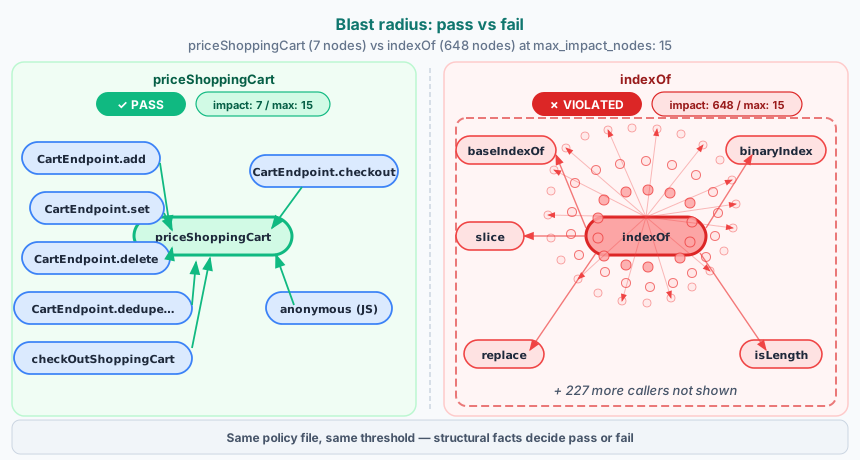
A function that passes
priceShoppingCart is the core pricing method in ShoppingCartService. Let’s check it:
rgctl -f json blast-radius priceShoppingCart --policy-file policy.json{
"gatekeeping": {
"policy_status": "PASS",
"violations": []
},
"metrics": {
"direct_callers_count": 5,
"impact_zone_size": 7,
"score": 40.35
},
"target": {
"symbol": "priceShoppingCart",
"canonical_fqn": "ShoppingCartService::priceShoppingCart",
"file_path": "src/main/java/com/redhat/coolstore/service/ShoppingCartService.java",
"language": "java",
"signature": "public void priceShoppingCart(ShoppingCart sc) {"
},
"topology": {
"direct_callers": [
{"fqn": "com.redhat.coolstore.rest.CartEndpoint.add"},
{"fqn": "com.redhat.coolstore.rest.CartEndpoint.dedupeCartItems"},
{"fqn": "com.redhat.coolstore.rest.CartEndpoint.set"},
{"fqn": "com.redhat.coolstore.service.ShoppingCartService.checkOutShoppingCart"},
{"fqn": "com.redhat.coolstore.rest.CartEndpoint.delete"}
],
"impact_zone": [
{"fqn": "com.redhat.coolstore.rest.CartEndpoint.add"},
{"fqn": "com.redhat.coolstore.rest.CartEndpoint.dedupeCartItems"},
{"fqn": "com.redhat.coolstore.rest.CartEndpoint.delete"},
{"fqn": "com.redhat.coolstore.rest.CartEndpoint.set"},
{"fqn": "com.redhat.coolstore.service.ShoppingCartService.checkOutShoppingCart"},
{"fqn": "com.redhat.coolstore.rest.CartEndpoint.checkout"},
{"fqn": "anonymous"}
]
}
}policy_status: "PASS". The impact zone is 7 nodes – well under the 15-node limit. Five direct callers, all in CartEndpoint and ShoppingCartService itself. Changing priceShoppingCart affects a contained, well-defined set of functions. This is what healthy coupling looks like.
A function that violates
Now check indexOf from the bundled lodash:
rgctl -f json blast-radius indexOf --policy-file policy.json{
"gatekeeping": {
"policy_status": "VIOLATED",
"violations": [
{
"kind": "scale_failure",
"count": 648,
"max": 15
}
]
},
"metrics": {
"direct_callers_count": 232,
"impact_zone_size": 648,
"score": 72.4
},
"target": {
"symbol": "indexOf",
"file_path": "src/main/webapp/bower_components/lodash/lodash.js"
}
}policy_status: "VIOLATED". 232 direct callers, 648 nodes in the impact zone. Changing indexOf could affect 648 functions across the entire application. The policy rightfully flags this – nobody should modify a vendored lodash function without understanding that scope.
Tight policy on Java service code
Let’s use a tighter policy (max_impact_nodes: 8) and check getShoppingCart:
rgctl -f json blast-radius getShoppingCart \
  --policy-file policy-tight.json
{
"gatekeeping": {
"policy_status": "VIOLATED",
"violations": [
{
"kind": "scale_failure",
"count": 10,
"max": 8
}
]
},
"metrics": {
"direct_callers_count": 6,
"impact_zone_size": 10,
"score": 40.5
},
"target": {
"symbol": "getShoppingCart",
"canonical_fqn": "ShoppingCartService::getShoppingCart"
}
}With a limit of 8, getShoppingCart violates – its impact zone is 10. Six direct callers (CartEndpoint.add, CartEndpoint.set, CartEndpoint.delete, CartEndpoint.dedupeCartItems, CartEndpoint.getCart, ShoppingCartService.checkOutShoppingCart) plus their downstream consumers push it over. Raise the threshold to 10 and it passes. This is the kind of tuning that policy files are designed for.
Java application violations at moderate thresholds
With max_impact_nodes: 10, the Java application code starts surfacing alongside the vendor JavaScript:
| Symbol | Impact zone | File |
|---|---|---|
getShoppingCartItemList | 12 | ShoppingCart.java |
getProductByItemId | 11 | ProductService.java |
toProduct | 14 | Transformers.java |
getCartItemTotal | 11 | ShoppingCart.java |
getShippingTotal | 11 | ShoppingCart.java |
getInventory | 18 | CatalogItemEntity.java |
getCatalogItemById | 15 | CatalogService.java |
These are the Java functions that fan out the most. getInventory has the largest blast radius at 18 nodes – it is used by CatalogItemEntity which feeds into CatalogService, ProductService, and ultimately the REST endpoints. During a migration from WebLogic to, say, Quarkus, these are the functions you would want to refactor first – they touch the most downstream code.
Permissive vs strict policies
Permissive: baseline for a monolith
Start with a high threshold to establish the pipeline and see what you are dealing with:
{"max_impact_nodes": 500, "centrality_alert_threshold": 0.95}rgctl -f json check --policy-file policy-permissive.json{
"schema_version": 1,
"policy": "policy-permissive.json",
"passed": false,
"violations": [
{"symbol": "baseIndexOf", "error": "Graph error: scale failure: impact zone size 649 exceeds max 500"},
{"symbol": "binaryIndex", "error": "Graph error: scale failure: impact zone size 659 exceeds max 500"},
{"symbol": "isIterateeCall", "error": "Graph error: scale failure: impact zone size 818 exceeds max 500"},
{"symbol": "join", "error": "Graph error: scale failure: impact zone size 607 exceeds max 500"},
{"symbol": "isLength", "error": "Graph error: scale failure: impact zone size 900 exceeds max 500"},
{"symbol": "slice", "error": "Graph error: scale failure: impact zone size 697 exceeds max 500"},
{"symbol": "isIndex", "error": "Graph error: scale failure: impact zone size 856 exceeds max 500"},
{"symbol": "replace", "error": "Graph error: scale failure: impact zone size 899 exceeds max 500"},
{"symbol": "baseSlice", "error": "Graph error: scale failure: impact zone size 883 exceeds max 500"},
{"symbol": "indexOf", "error": "Graph error: scale failure: impact zone size 648 exceeds max 500"},
{"symbol": "indexOfNaN", "error": "Graph error: scale failure: impact zone size 659 exceeds max 500"},
{"symbol": "binaryIndexBy", "error": "Graph error: scale failure: impact zone size 660 exceeds max 500"},
{"symbol": "isObjectLike", "error": "Graph error: scale failure: impact zone size 745 exceeds max 500"}
]
}Even at 500, 13 functions still violate. All of them are lodash internals. The Java application code passes entirely. This tells you the vendor JavaScript is the structural risk, not the Java services.
Strict: zero tolerance
{"max_impact_nodes": 0}A max_impact_nodes of 0 means any function with any downstream consumer triggers a failure. Useful for smoke-testing the pipeline or for isolated modules where every function is expected to be a leaf.
Domain isolation
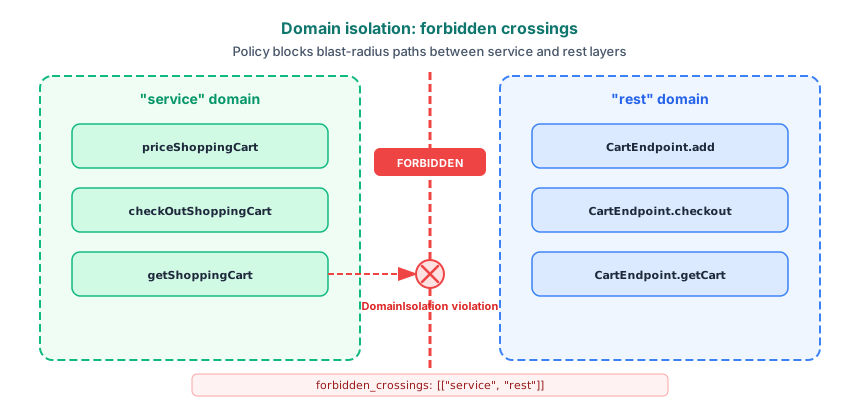
You are migrating CoolStore from WebLogic. The REST layer and the service layer must not grow new cross-layer dependencies. You want CI to catch any function whose blast radius crosses from service into rest (or vice versa).
Step 1: Find the node UUIDs for functions in each layer:
rgctl -f json gql \
  "MATCH (n:Function) WHERE n.file_path CONTAINS 'service/' RETURN n"
Each node in the response includes an id field (UUID). Collect the UUIDs for the service-layer functions and the REST-layer functions.
Step 2: Build the policy:
{
  "max_impact_nodes": 50,
  "forbidden_crossings": [["service", "rest"]],
  "node_domains": {
    "60a84e0c-7366-4e65-8c41-98b4411c7d36": "service",
    "26135ad3-6fa3-4fab-bca6-32607ddbff72": "service",
    "b311845f-2bb1-43c5-99b5-90d2e7d6f60b": "service",
    "fd95d5e1-a959-4d7c-92d4-bd20de91dc45": "rest",
    "004895d9-7ebd-46ed-b92f-84ca01ccfed2": "rest",
    "73fb42ed-45dd-46af-86e9-f1306995916c": "rest"
  }
}
Step 3: Run the check. Any blast-radius path that crosses from a service node to a rest node (or vice versa) triggers a DomainIsolation violation.
The crossing check is bidirectional. Declaring ["service", "rest"] blocks both directions.
Git-aware scoping
The check command is git-aware. When run inside a git repository, it extracts the list of changed files from git diff --name-only HEAD and only evaluates functions defined in those files. This keeps CI fast – on a 7,500-function codebase like CoolStore, you only pay for the functions you actually changed.
If git is unavailable or the diff is empty, the check falls back to evaluating every function in the graph.
GitHub Actions integration
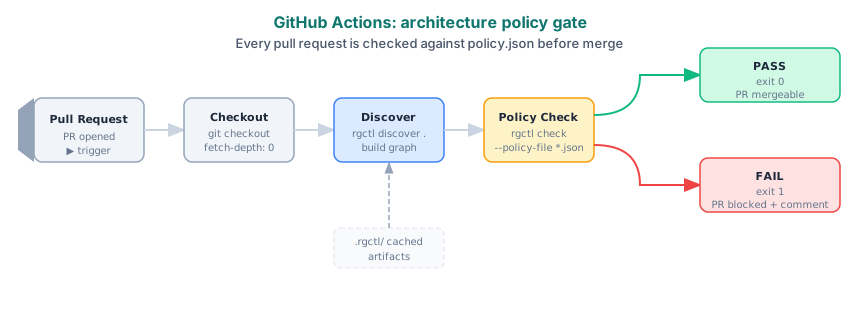
Here is a complete GitHub Actions workflow that runs rgctl policy checks on every pull request:
name: Architecture Policy Check

on:
  pull_request:
    branches: [main]

jobs:
  policy-check:
    runs-on: ubuntu-latest
    steps:
      - uses: actions/checkout@v4
        with:
          fetch-depth: 0  # full history for git diff

      - name: Install rgctl
        run: |
          curl -fsSL https://github.com/sshaaf/rgctl/releases/latest/download/rgctl-linux-x86_64.tar.gz \
            | tar xz -C /usr/local/bin

      - name: Discover codebase
        run: rgctl discover .

      - name: Run policy check
        run: rgctl -f json check --policy-file policy.json
The workflow does four things:
- Checks out the full git history (
fetch-depth: 0). This is required forgit diffto work correctly – rgctl needs to compare the working tree against HEAD to identify changed files. - Installs rgctl from the latest release.
- Discovers the codebase to build the knowledge graph. This step runs once and persists the graph to
.rgctl/. - Runs the policy check against
policy.jsonat the repository root. If any violation is found, the step fails with exit code 1 and the pull request is blocked.
Adding violation details to PR comments
For better developer experience, pipe the JSON output into a PR comment:
      - name: Run policy check
        id: policy
        continue-on-error: true
        run: |
          rgctl -f json check --policy-file policy.json > policy-result.json
          echo "passed=$(jq -r .passed policy-result.json)" >> "$GITHUB_OUTPUT"

      - name: Comment on PR
        if: steps.policy.outputs.passed == 'false'
        uses: actions/github-script@v7
        with:
          script: |
            const fs = require('fs');
            const result = JSON.parse(fs.readFileSync('policy-result.json', 'utf8'));
            const violations = result.violations
              .map(v => `- **${v.symbol}**: ${v.error || v.violation}`)
              .join('\n');
            const body = `## Policy Check Failed\n\n${result.violations.length} violation(s) found:\n\n${violations}`;
            github.rest.issues.createComment({
              issue_number: context.issue.number,
              owner: context.repo.owner,
              repo: context.repo.repo,
              body
            });

      - name: Fail if violations
        if: steps.policy.outputs.passed == 'false'
        run: exit 1
This posts a formatted comment listing every violation, so the developer can see exactly which functions broke the policy without digging into the CI logs.
Caching the graph
For large repositories, the discover step can take minutes. Cache the .rgctl/ directory to skip re-indexing when the source has not changed:
      - name: Cache rgctl graph
        uses: actions/cache@v4
        with:
          path: .rgctl
          key: rgctl-${{ hashFiles('**/*.java', '**/*.ts', '**/*.py') }}
          restore-keys: rgctl-

      - name: Discover codebase
        run: rgctl discover .
When the cache hits, discover detects the existing graph and skips the indexing step.
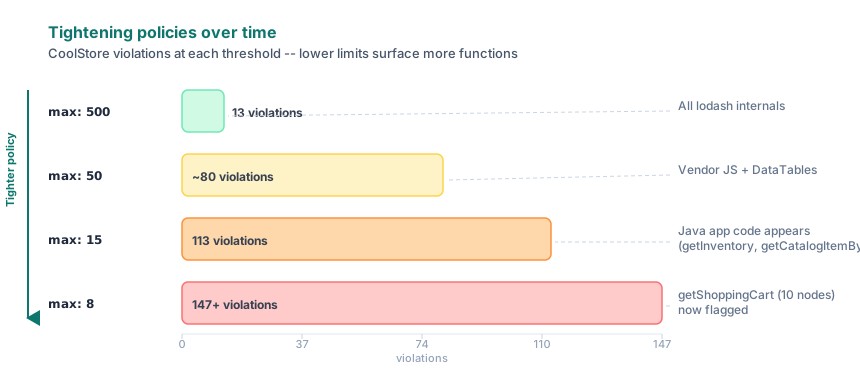
Tightening policies over time
A practical adoption path for CoolStore (or any monolith):
- Week 1: Deploy with a permissive policy (
max_impact_nodes: 500). On CoolStore, this catches 13 lodash internals and lets all Java application code pass. This is your baseline. - Week 2-4: Lower the threshold (
max_impact_nodes: 50). The vendor JavaScript dominates the violations. Consider excludingbower_components/from indexing if vendor code is not your concern. - Month 2: Add
centrality_alert_threshold: 0.8. Start catching bridge functions that connect otherwise separate subsystems. - Month 3+: Tighten to
max_impact_nodes: 15. Now Java application functions likegetInventory(18 nodes) andgetCatalogItemById(15 nodes) start appearing. These are your refactoring targets. - Ongoing: Add
forbidden_crossingsfor module boundaries you want to enforce. Assignnode_domainsto the key functions in each domain.
Each step produces measurable progress. The violation count in CI is your metric.
Summary
| What | How |
|---|---|
| Define rules | Write a policy.json with thresholds and domain boundaries |
| Check locally | rgctl -f json check --policy-file policy.json |
| Check one function | rgctl -f json blast-radius priceShoppingCart --policy-file policy.json |
| CI gate | Add to GitHub Actions; exit code 1 blocks the PR |
| Start permissive | {"max_impact_nodes": 500} – catches only the worst offenders |
| Get strict | {"max_impact_nodes": 15, "centrality_alert_threshold": 0.8} |
| Enforce boundaries | Add forbidden_crossings and node_domains |
Architecture rules should not live in people’s heads. They should live in a JSON file, evaluated on every pull request, with a clear pass/fail signal. That is what rgctl policy checks give you.
The CoolStore WebLogic source is at github.com/sshaaf/coolstore-weblogic. Clone it, run rgctl discover ., write a policy.json, and see what breaks.